
Appearance
Zal Ultra API Integration
Introduction
Zal Ultra ISP CRM provides a powerful API that allows you to manage subscribers, invoices, payments, and more. This page explains how to test the Zal Ultra API with Postman: downloading and importing the collection, setting its variables, authenticating, and sending requests. Every endpoint, with code examples, is described in the API documentation.
Prerequisites
Before getting started, make sure you have:
Running Zal Ultra ISP CRM installation with API enabled.
Postman account (Free version is enough).
The Zal Ultra API Postman Collection (download it below).
Download the Collection
Download the ready-made collection and import it into Postman:
👉 Download Zal Ultra API Postman Collection
It has the Zal Ultra API requests in five folders: Public, Auth, Subscriber (the subscriber portal and mobile app API), User (the staff API) and Payment Gateways.
Always check the API documentation
The Postman collection is a starting point, not the full reference. We update the API documentation more often than the collection, so new endpoints, changed fields, validation rules and response formats may appear there before they reach the collection.
Importing the JSON file alone is not enough: before you build against an endpoint, check it in the API documentation, and download the collection again from time to time.
Check again after every Zal Ultra update. We update Zal Ultra and its API from time to time, and any update can change an endpoint: its address, required fields, permissions, validation or response. After each update:
- Read the Changelog (in your Zal Ultra panel, Changelog in the left sidebar) for API changes.
- Review the API documentation for every endpoint your integration or app uses.
- Test your integration before relying on it in production.
Import into Postman
- Open Postman and click Import (top-left corner).
- Drag and drop the downloaded
zalultra_api.postman_collection.jsonfile, or browse to it. - Click Import. The Zal Ultra API Collection appears in your sidebar.
Set the Collection Variables
Select the Zal Ultra API Collection in the sidebar and open the Variables tab. Set these once and every request uses them:
| Variable | What to put in it |
|---|---|
zalultra_url | Your Zal Ultra address, e.g. https://isp.example.com |
zalultra_email | Staff login email or username |
zalultra_password | Staff login password |
zalultra_token | The token returned by the staff login (see below) |
zalultra_sub_username | A subscriber's username, for the Subscriber requests |
zalultra_sub_password | That subscriber's password |
subscriber_token | The token returned by the subscriber login |
The collection uses as its Bearer token, so once it is set you do not have to paste the token into each request. Click Save after changing the variables.
WARNING
Keep your passwords and tokens in your own Postman copy. Do not share an exported collection that has them filled in.
Authenticate & Collect Token
- In the imported collection, open the Auth → User folder and its login request (use Auth → Subscriber for a subscriber login).
- Set your email and password in the
zalultra_emailandzalultra_passwordvariables (provided by your admin). - Click Send.
- In the response, you will see a token field.
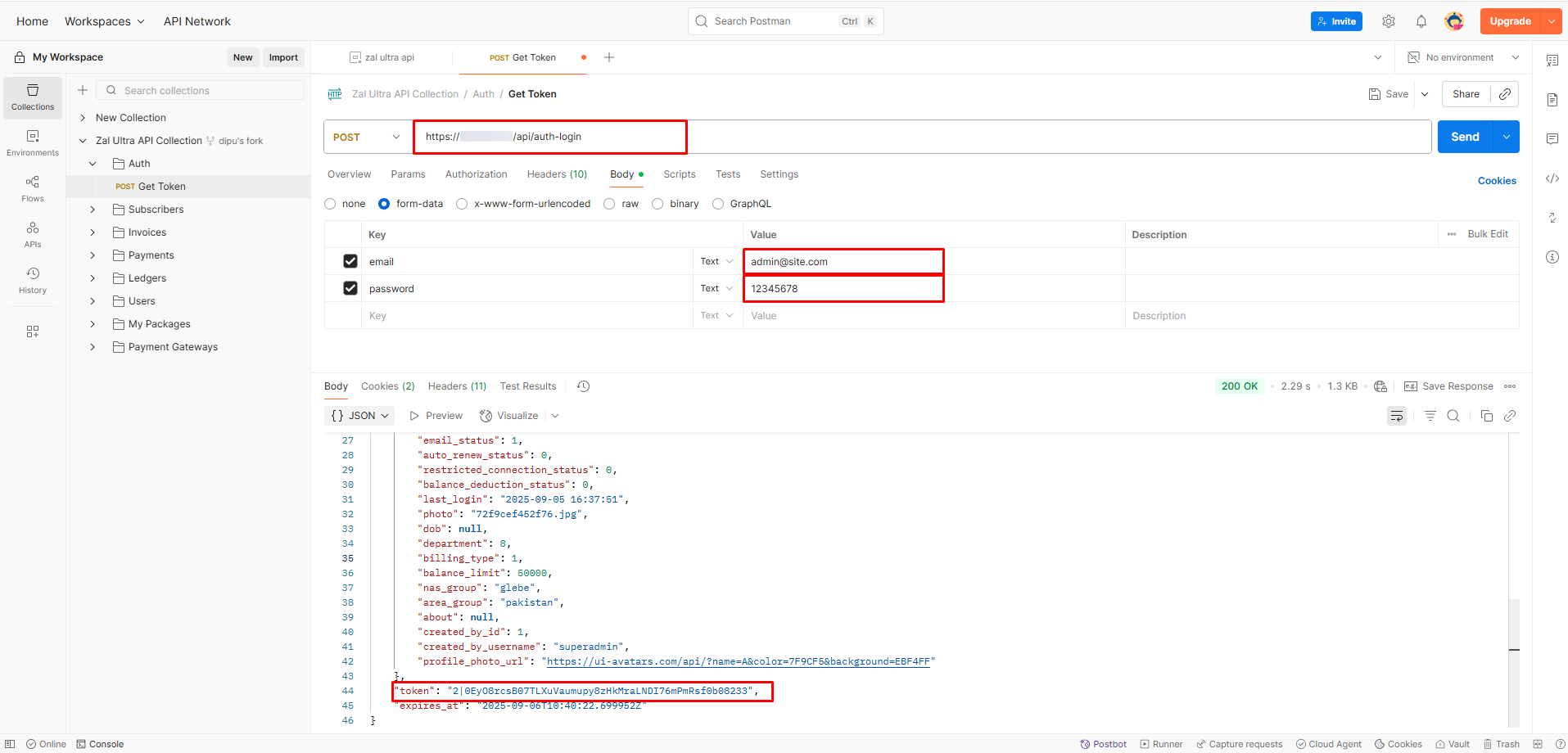
Note: Copy the entire token, including the 2| prefix.
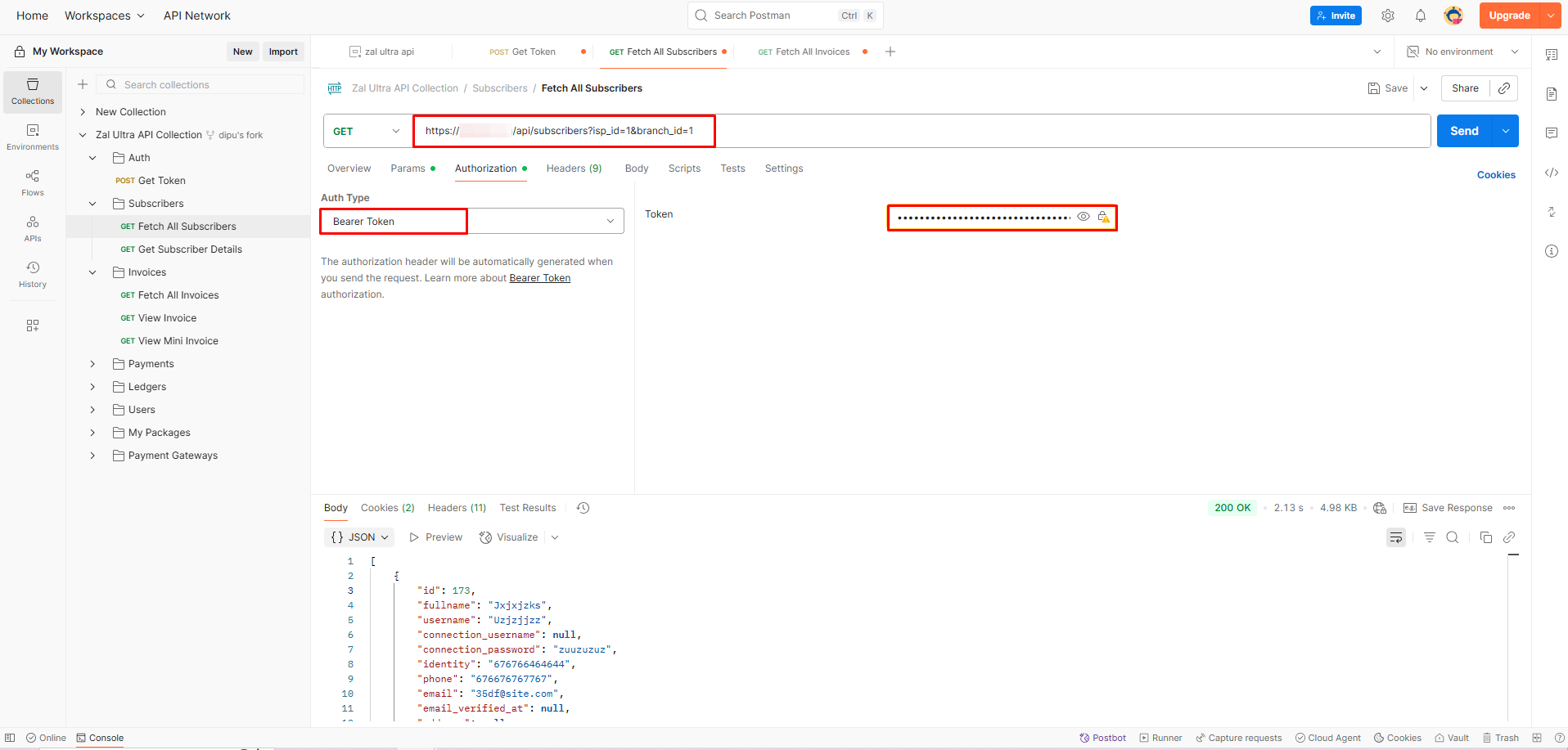
Set Authorization with Bearer Token
Paste the token into the zalultra_token collection variable (Subscriber requests use subscriber_token). Or, for a single request:
- Open any request in the collection.
- Go to the Authorization tab.
- Choose Bearer Token as the type.
- Paste your token into the token field.
Fetch Data
- Now, select any API request (e.g., List Subscribers, Invoices, Payments).
- Click Send.
- The API will return the requested data in JSON format.
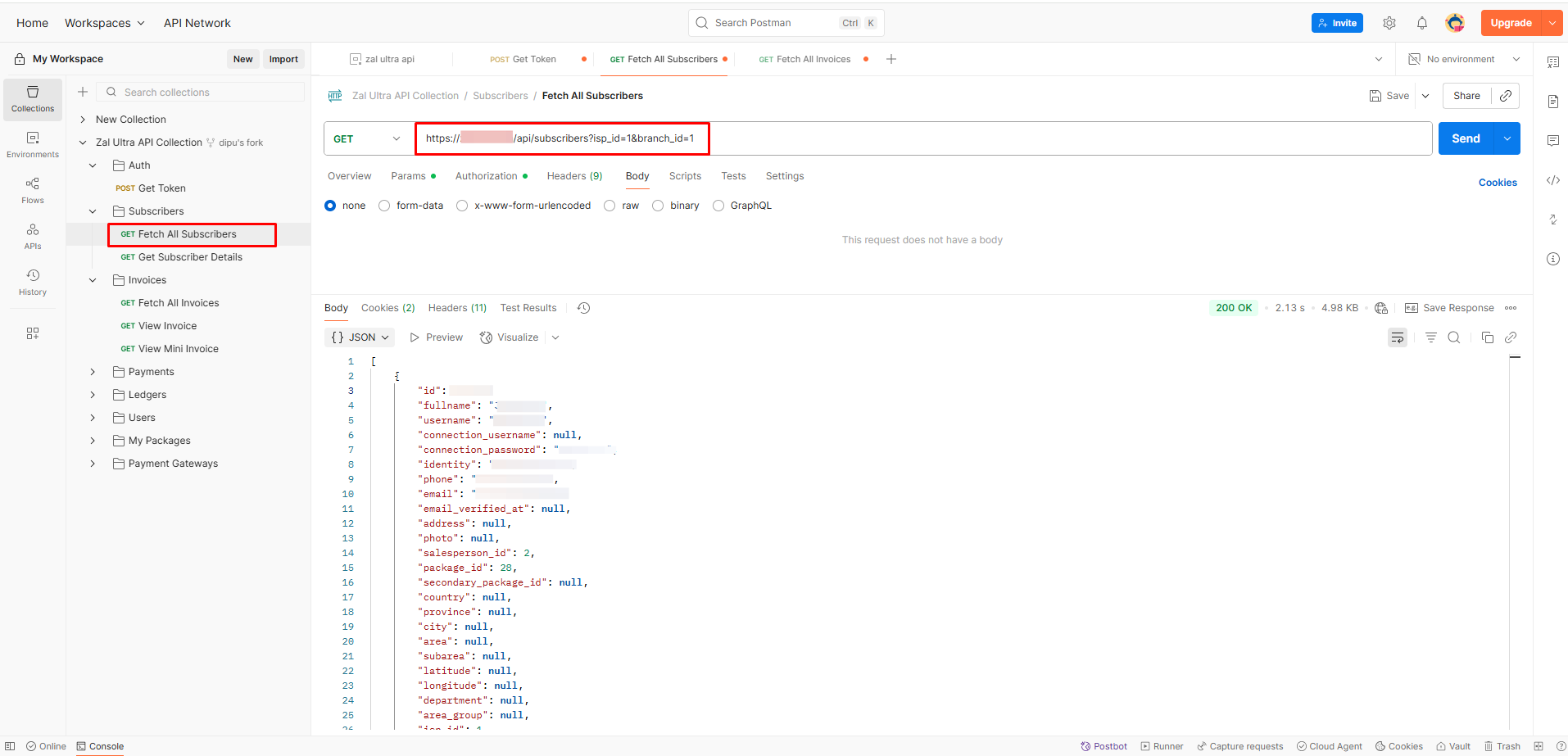
Note: Always verify whether your API base URL uses http:// or https://.
- Use https:// in production for secure communication.
- http:// may only work on local development servers (e.g., http://127.0.0.1:8000). If you use the wrong protocol, requests may fail or be blocked by the browser.